
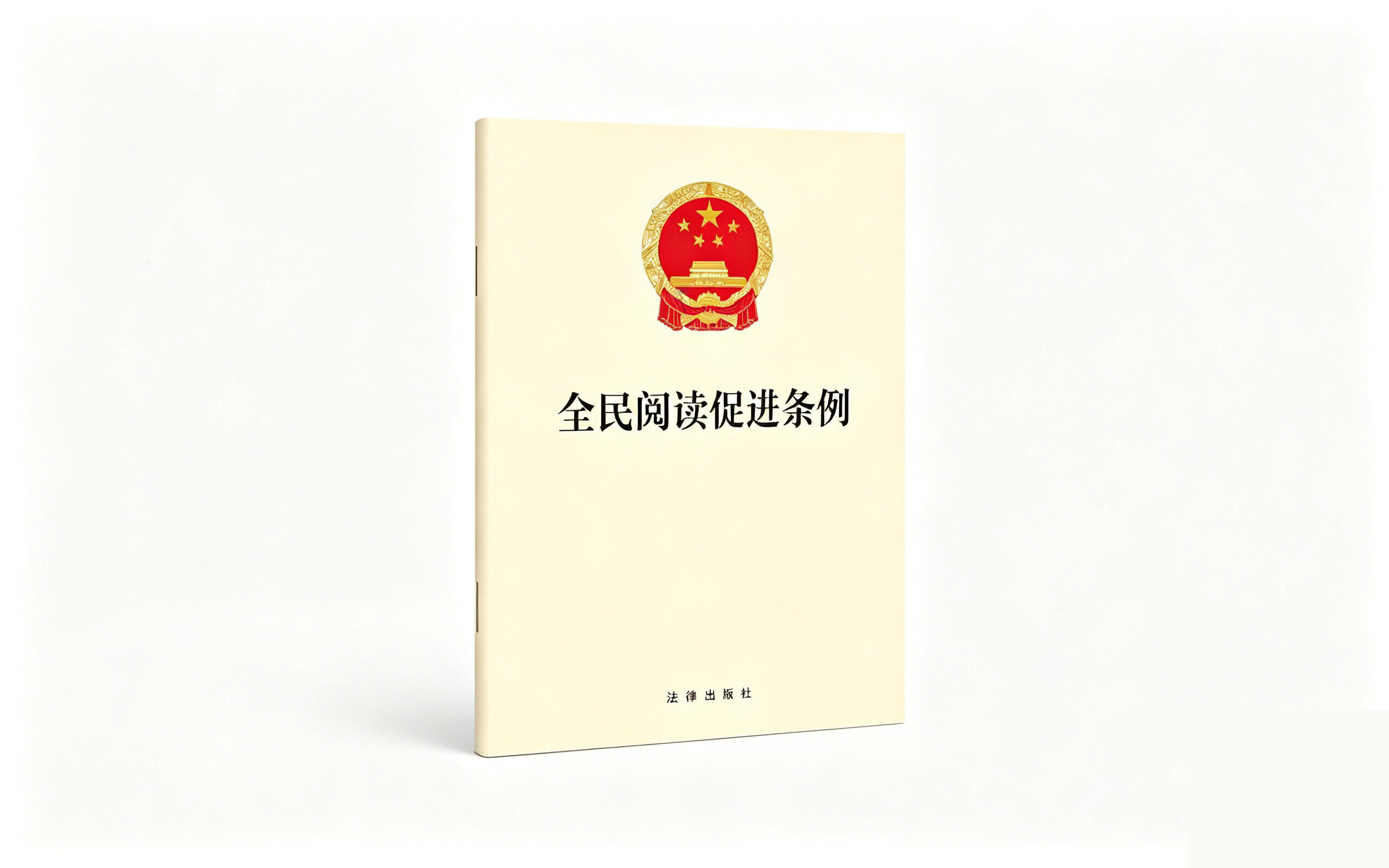
Regulations on Promoting National Reading
Order of the State Council of the People's Republic of China
No. 823
The "Regulations on Promoting National Reading" were adopted at the 73th executive meeting of the State Council on 2025/11/27 and are hereby promulgated, effective as of 2026/2/1.
Premier Li Qiang
2025-12-9
Regulations on Promoting National Reading
Chapter 1: General Provisions
FirstThis Ordinance is enacted to promote nationwide reading, advance the construction of a book-loving society, enhance the moral, ideological, scientific, and cultural literacy of the entire nation, raise the level of social civilization, and foster the development of China into a leading socialist cultural power.
SecondThe national reading promotion initiative adheres to the leadership of the Communist Party of China, guided by Xi Jinping Thought on Socialism with Chinese Characteristics for a New Era and Xi Jinping's Cultural Thought. It is people-centered, upholds cultural confidence, advances socialist advanced culture, promotes revolutionary culture, and inherits excellent traditional Chinese culture.
The National Reading Promotion Initiative is guided by the core values of socialism, disseminating scientific and cultural knowledge that fosters citizens' comprehensive development and social progress. It aims to ignite reading interest, cultivate reading habits, enhance reading skills, improve reading quality, and create a widespread culture where everyone loves reading, reads quality books, and reads effectively.
ThirdThe national reading promotion initiative is led by the Party committee, guided by the government, and supported by social forces. In line with the principles of public welfare, accessibility, equity, and convenience, it builds a comprehensive, inclusive, and efficient reading promotion system to foster civilized values, deepen patriotism, and strengthen the spiritual drive for the great rejuvenation of the Chinese nation.
Article 4The nation is strengthening efforts to promote national reading.
Local people's governments at or above the county level shall strengthen coordination and overall planning for the promotion of national reading within their administrative areas.
Article 5The national publication and press authority is responsible for promoting nationwide reading. Relevant departments of the State Council handle related reading promotion work within their respective responsibilities.
Local public security, press, and publication authorities at or above the county level are responsible for promoting reading throughout their administrative regions. Relevant departments of local people's governments at or above the county level shall carry out related work on promoting reading within their respective duties and responsibilities.
Article 6The national publication and press administration, in coordination with relevant departments of the State Council, shall develop a comprehensive plan for promoting national reading, specifying its objectives, tasks, and measures.
Local new and publication authorities at or above the county level shall, in coordination with relevant departments at the same level, develop implementation plans for promoting national reading within their administrative regions based on local conditions.
Article 7Local people's governments at or above the county level shall, in light of actual conditions, allocate funding for national reading promotion within their respective budgets, improve the reading service system, create a favorable reading environment, and enhance the effectiveness of reading services.
Article 8Mass organizations such as trade unions, Communist Youth Leagues, women's federations, federations of literary and art circles, writers' associations, science and technology associations, and federations for persons with disabilities shall promote nationwide reading activities in accordance with their respective characteristics.
Article 9The state supports and guides the diversification of publications, optimizes their structure, enhances quality, and promotes outstanding works characterized by profound ideas, exquisite artistry, and superior production—while expanding the supply of high-quality content for national reading.
Article 10Units and individuals that have made significant contributions to the promotion of national reading shall be commended in accordance with relevant state regulations.
Chapter 2: Promoting National Reading
Article 11The government encourages promoting nationwide reading activities that are uplifting, culturally rich, and diverse in format. It advocates integrating these initiatives with local and industry-specific characteristics to enhance appeal, boost participation, and ensure tangible results.
Article 12Newspaper and publishing authorities at or above the county level, in coordination with relevant departments at the same level, shall strengthen the promotion of national reading by organizing promotional activities and cultivating branded reading events.
Newspaper and publishing authorities at or above the county level shall organize public reading campaigns to encourage citizens to read classics, elevate their spiritual well-being, and adopt a lifelong learning mindset.
Article 13The fourth week of 4 each year is National Reading Week.
Article 14Competent authorities such as the National Press and Publication Administration shall, within their respective mandates, promote outstanding publications in areas including innovative theories of the Party, philosophy and social sciences, literature and art, and science and technology, while guiding citizens to read high-quality content.
Article 15Promoting universal reading requires expertise in the relevant field, the dissemination of high-quality reading content, and the upholding of socialist core values.
Article 16Newspapers, periodicals, news agencies, radio and television stations, and news websites shall promote exemplary publications and outstanding figures in nationwide reading through news reports, special programs, and public service announcements. They should also advance nationwide reading activities and foster a culture of reading across society.
Article 17The state encourages the development and application of new technologies, platforms, and facilities for national reading, supports the use of information technology to promote national reading initiatives, and expands their impact.
Article 18Local people's governments at or above the county level shall, in accordance with national regulations, support social forces in promoting national reading on the basis of standardization and guidance.
When social organizations conduct national reading promotion activities, they shall accept guidance and supervision from the publishing and press authorities at or above the county level.
Chapter 3: Public Reading Services
Article 19Local people's governments at or above the county level shall, in accordance with requirements for basic public cultural services, strengthen the coordinated use of relevant venues and facilities, scientifically plan and design public reading infrastructure, and systematically establish a network of public reading facilities that covers urban and rural areas, is practical and convenient, and delivers efficient services.
Public reading facilities include public libraries, new-era civilization practice centers (stations), workers' cultural palaces, youth centers, women and children activity centers, senior citizen activity centers, grassroots comprehensive cultural service centers at the township/street and village/community levels, community libraries, farm/p worker book rooms, public newsstands (screens), and public digital reading terminals operated by government or social organizations to provide reading services to the public.
Article 20Public reading facility operators shall provide services such as reading, borrowing, reading guidance, and literacy training based on the facilities' functions and characteristics. They must publicize service offerings, improve service conditions, and enhance service quality. Public libraries shall offer free access to reading rooms and study areas, equipped with desks and chairs, and provide related reading services.
Facility management units for national reading programs shall configure and update essential services and equipment in accordance with national standards, conduct regular maintenance and management of these facilities, and ensure their safe operation and use.
Public reading facilities that meet the criteria shall open to the public free of charge or at a discounted rate in accordance with national regulations and must publish their opening hours. Facilities with adequate resources may extend their operating hours during national statutory holidays, weekends, and school breaks.
Public reading facility operators shall establish and improve safety management systems, equip themselves with safety protection devices and personnel in accordance with the law, and ensure the safety of public reading facilities and public activities.
Article 21Public cultural facilities included in the construction, renovation, and expansion of residential areas shall incorporate universal reading facilities to provide reading services for residents.
Article 22No individual or entity may dismantle public reading facilities, alter their function or use, or hinder their normal operation without authorization. If such dismantling or modification is absolutely necessary for urban and rural development, public reading facilities shall be rebuilt or renovated in accordance with the law.
Article 23The state encourages public service institutions and venues such as train stations, airports, bus terminals, visitor centers, hotels, banks, shopping malls, and hospitals to establish reading facilities. It also supports providing accessible reading services on public transportation where feasible, including airplanes, ships, and trains.
Park and scenic area management units may install suitable reading facilities based on their conditions.
Article 24The government encourages government agencies, schools, enterprises, and public institutions to offer diverse reading services tailored to their specific conditions and needs by establishing libraries, reading rooms, newspaper and periodical racks, and display boards (or screens).
Article 25Local people's governments at or above the county level shall, based on local conditions, adopt policies and measures to support the development of physical bookstores. They are encouraged to improve reading facilities, organize reading activities, and fulfill their role in serving national reading initiatives.
Article 26The government supports combining digital and traditional reading, promotes the supply of high-quality digital reading content, and enhances the convenience and satisfaction of digital reading.
Digital reading service providers shall strengthen content management, promote high-quality digital reading content, and foster a healthy and positive digital reading environment.
Article 27The state encourages and supports the high-quality development of cultural industries related to promoting national reading. It also encourages and supports social forces in building public reading spaces, facilitating used book exchanges, innovating reading service models, and enriching national reading scenarios.
The state encourages and supports social forces to participate in providing reading services through various lawful means, including establishing entities, funding projects, sponsoring activities, providing facilities, and donating publications.
Chapter 4: Guaranteeing National Reading
Article 28The state is strengthening support for nationwide reading, expanding its reach, and prioritizing assistance to rural areas, revolutionary base areas, ethnic regions, border regions, and underdeveloped areas to promote balanced and coordinated development of nationwide reading.
Article 29The national press and publication administration, in coordination with relevant State Council departments, shall develop a reading plan for children and adolescents. This plan promotes staged reading tailored to their cognitive development and comprehension abilities, and implements reading guidance activities aligned with their unique reading characteristics and patterns.
Publishers should produce age-appropriate publications for children and adolescents in alignment with the tiered reading requirements.
Public libraries established by the government shall provide reading areas for children and young people, staffed with qualified professionals to offer age-appropriate reading guidance.
Article 30Parents or other guardians of minors should lead by example and conduct feasible family reading and parent-child reading activities to help minors develop good reading habits.
Article 31Kindergartens should provide age-appropriate reading materials, create a supportive reading environment, and foster children's interest in and habit of reading.
Article 32Primary and secondary schools shall strengthen the construction of book-rich campuses in line with quality education requirements, increase the emphasis on reading in teaching plans, offer reading courses, provide reading guidance, organize campus reading activities to help students develop reading habits, and enhance teacher training in reading instruction to improve their guiding capabilities.
Article 33Higher education institutions should treat reading as a key pedagogical approach, organize diverse reading activities for students, encourage expanded reading content, enrich students' intellectual lives, and enhance their overall competencies.
Article 34The national publishing and press administration, in coordination with relevant departments of the State Council, shall formulate a rural reading program. Local publishing and press administrations at or above the county level, in collaboration with their counterparts, shall strengthen their responsibilities for promoting rural reading by expanding the supply of reading materials, optimizing reading environments, improving service efficiency, and ensuring robust reading support services for rural women and children. These efforts aim to promote equal access to basic public cultural services across urban and rural areas and enrich the spiritual lives of rural communities.
Publications for rural areas should align with local characteristics and needs, enhancing relevance and timeliness.
Article 35The state enhances the ability of people from all ethnic groups to read in the national common language and script, supports reading activities using this language in ethnic regions, promotes ethnic unity and progress, and strengthens the sense of community for the Chinese nation.
Article 36The state has designated "City of Reading" and "Village of Reading" as key components of spiritual civilization development, fostering a culture of reading across society and advancing urban civilization and rural cultural development.
Article 37The state encourages the provision of accessible-format publications—including audio, large print, Braille, and digital versions—for people with reading disabilities, and supports the development of barrier-free infrastructure for universal reading.
Disabled persons service agencies shall provide necessary reading assistive facilities and corresponding services to persons with disabilities.
Article 38Public reading facility operators should account for the needs and characteristics of older adults by providing age-appropriate content, optimizing senior-friendly service standards, and ensuring convenient access to reading resources.
Conditional senior universities (schools) and elderly care service institutions shall organize reading activities for older adults and enhance the quality of their reading services.
Article 39The state encourages research on national reading, guides surveys on citizens' reading habits, and supports international cooperation and exchanges in national reading.
Article 40Donations made through public welfare social organizations or people's governments at or above the county level for national reading services are eligible for tax incentives as prescribed by law.
Article 41County-level and above news and publication authorities, in coordination with relevant departments at the same level, shall supervise reading activities and optimize the reading environment in accordance with the law.
No unit or individual may harm national interests, public interests, the lawful rights and interests of others, or the physical and mental well-being of citizens during reading activities.
Chapter 5: Legal Liability
Article 42Violations of these Regulations by local people's governments at all levels and relevant departments at or above the county level, including their staff, shall be addressed as follows: if they fail to fulfill their responsibilities for promoting national reading, misappropriate or embezzle funds designated for national reading, or engage in other acts of abuse of power, negligence of duty, or favoritism and fraud, the higher-level authority or supervisory agency shall order them to correct the violations within a specified time limit. In serious cases, responsible leaders and directly accountable personnel shall be subject to disciplinary action in accordance with the law.
Article 43If a public reading facility management unit violates these regulations by failing to open facilities to the public as required, failing to display service items and opening hours, failing to establish safety management systems or to equip adequate safety devices and personnel, or conducting activities inconsistent with the facility's designated functions or uses, its competent authority shall order it to make corrections within a specified time limit. If serious consequences occur, responsible leaders and directly accountable personnel shall be disciplined in accordance with the law.
Article 44Violating these regulations and infringing upon the civil rights of others shall result in civil liability as prescribed by law; if it constitutes a violation of public security administration, administrative penalties shall be imposed according to law; and if it constitutes a crime, criminal responsibility shall be pursued in accordance with the law.
Chapter 6 Supplementary Provisions
Article 45This regulation shall take effect on 2026/2/1.
Need to publish a book? Consult a professional publishing consultant now.
Free Manuscript EvaluationRelated News
Prohibited Content in Formal Book Publishing and Regulations on Forbidden Material
2026/09/11
Why self-publish when you've already written a manuscript?
2026/08/17

Listen to the Voices of the New Generation: "Dialogue with Young People" Now Available – Bridging Generational Gaps
2026/07/23

New Epic of the Wanli Era: "The Legend of the Righteous" Published, Chronicling Late Ming Turmoil with Patriotism and Chivalry
2026/07/23